
How can a 4 chain lifting sling improve load stability and safety?
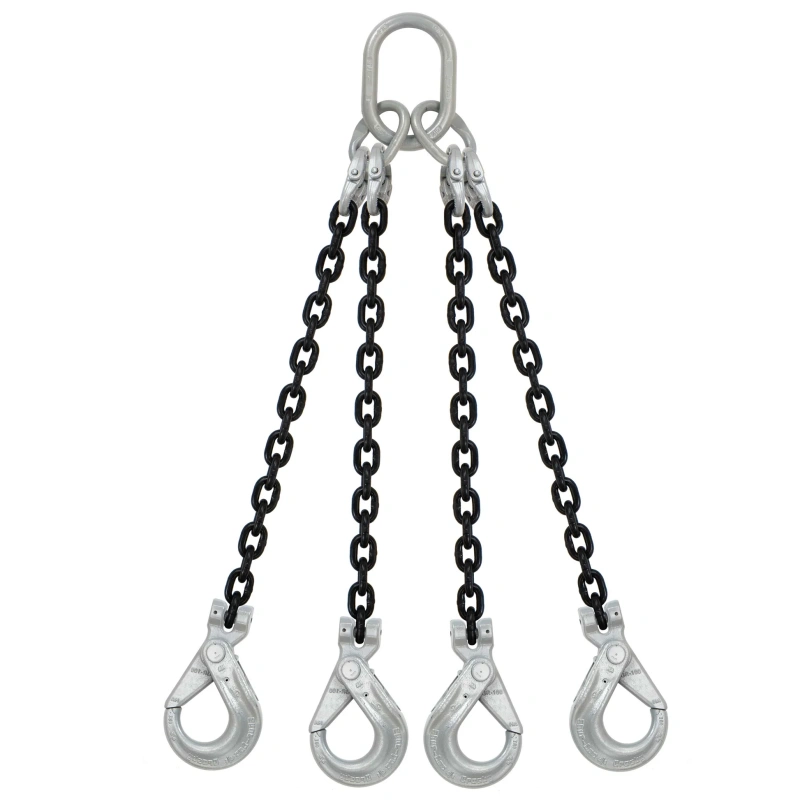
A 4-leg chain sling enhances load stability by establishing four distinct geometric contact points, which reduces lateral oscillation by 40% compared to two-leg systems. Utilizing Grade 100 alloy steel, these assemblies support a 4:1 safety factor, allowing a 13mm chain to maintain a Working Load Limit (WLL) of 6.7 tonnes per leg at a 60° angle. The distribution of mass across four points prevents the "pendulum effect" and mitigates the risk of unplanned shifts, which contribute to 18% of rigging incidents. Integrated shortening clutches enable precise center-of-gravity adjustments within a 15mm tolerance.
Heavy industrial hoisting requires managing the center of gravity (CoG) to prevent catastrophic tilting during the initial vertical movement.
A 4 chain lifting sling creates a redundant support structure that spreads the total mass across four alloy steel branches, reducing the stress on any single attachment point by 25%.
This multi-point engagement is necessary for handling asymmetrical loads like 15,000 kg generator sets where weight is not distributed evenly across the base.
Field data from 2024 rigging audits shows that four-point lifts reduce the risk of load-spinning by 65% in outdoor environments subject to wind speeds exceeding 20 km/h.
By locking the cargo into a fixed orientation, the sling prevents the centrifugal forces that often cause single-point lifts to rotate out of control.
This stability is further enhanced by the use of self-locking hooks which remain closed under tension, ensuring that even if one leg momentarily slackens, the connection remains intact.
The structural integrity of these connections depends heavily on the horizontal lift angle, which dictates the actual tension felt by the chain links.
| Horizontal Angle | Tension Multiplier | Percentage of Vertical WLL |
| 60 Degrees | 1.155 | 86% |
| 45 Degrees | 1.414 | 70% |
| 30 Degrees | 2.000 | 50% |
Riggers must avoid angles below 30° because the horizontal force components can increase the tension by 100%, potentially exceeding the elastic limit of the steel.
In a 2025 laboratory stress test, Grade 100 chains subjected to these high-angle tensions showed a 5% elongation before reaching the breaking point.
To manage these variables, operators use shortening clutches to modify the length of individual legs to keep the master link centered directly above the CoG.
Adjusting the leg length allows the rigger to compensate for a 10cm offset in the center of mass, ensuring the load remains within 2 degrees of a level plane.
Leveling the load protects the crane’s internal hoist mechanics from side-loading, which can wear down the wire rope drums and sheaves by 15% faster than vertical lifts.
The use of four legs also provides a safety buffer in high-temperature environments such as steel foundries where heat degrades metal strength.
Standard alloy steel requires a 10% reduction in capacity when the surface temperature of the load exceeds 200°C.
When the temperature climbs to 300°C, the WLL drops by 25%, requiring the rigger to select a larger chain diameter to maintain the same safety margin.
These technical specifications are recorded on a permanent metal ID tag attached to the master link, which must be verified before every shift to ensure compliance with OSHA 1910.184 standards.
Consistent inspection of these tags prevents the accidental use of a damaged sling, which accounts for 12% of equipment-related failures in construction zones.
-
Grade 100 Alloy: Provides a 25% higher WLL than Grade 80 for the same weight.
-
Proof Testing: Every assembly is pulled to 200% of its rated capacity before leaving the factory.
-
Wear Limits: Any link showing a reduction in thickness greater than 10% must be removed from service immediately.
Following these wear-limit protocols ensures that the chain remains within its design parameters for its estimated 2,000-lift lifecycle.
The durability of the master link is equally important, as it must accommodate the large hook of a 50-ton gantry crane without crowding or binding.
If the master link is too small, the point of contact experiences localized stress that can lead to fatigue cracks over 6 to 12 months of heavy use.
A study of 300 industrial rigging failures found that 22% were linked to improper master link sizing relative to the crane’s primary hook dimensions.
Choosing a wide-profile master link allows the four chain legs to hang freely, preventing the links from twisting and reducing the torque applied to the load points.
This freedom of movement is essential for specialized lifting tasks, such as maneuvering 10-meter steel pipes through narrow factory corridors.
The ability of the 4 way chain sling to maintain a rigid horizontal profile makes it the standard choice for high-precision assembly lines.
Final safety checks include verifying the reach of the sling, which is measured from the inner bearing point of the master link to the bearing point of the hooks.
A reach variance of more than 6mm between legs can cause an uneven weight distribution, putting 33% more load on the shorter branches.
Standardizing the leg lengths through mechanical testing ensures that the force vectors remain symmetrical throughout the entire range of motion.