
Documents and Compliance in a Refillable Perfume Order
Compliance in a refillable perfume order is usually discussed as a fee, but it behaves like a paper trail produced at specific moments. Each document appears when a decision is taken, and each one costs money in a different way: some in testing, some in artwork, some only in the time it takes to obtain them. Mapping the trail to the timeline is what keeps compliance from landing on the critical path.
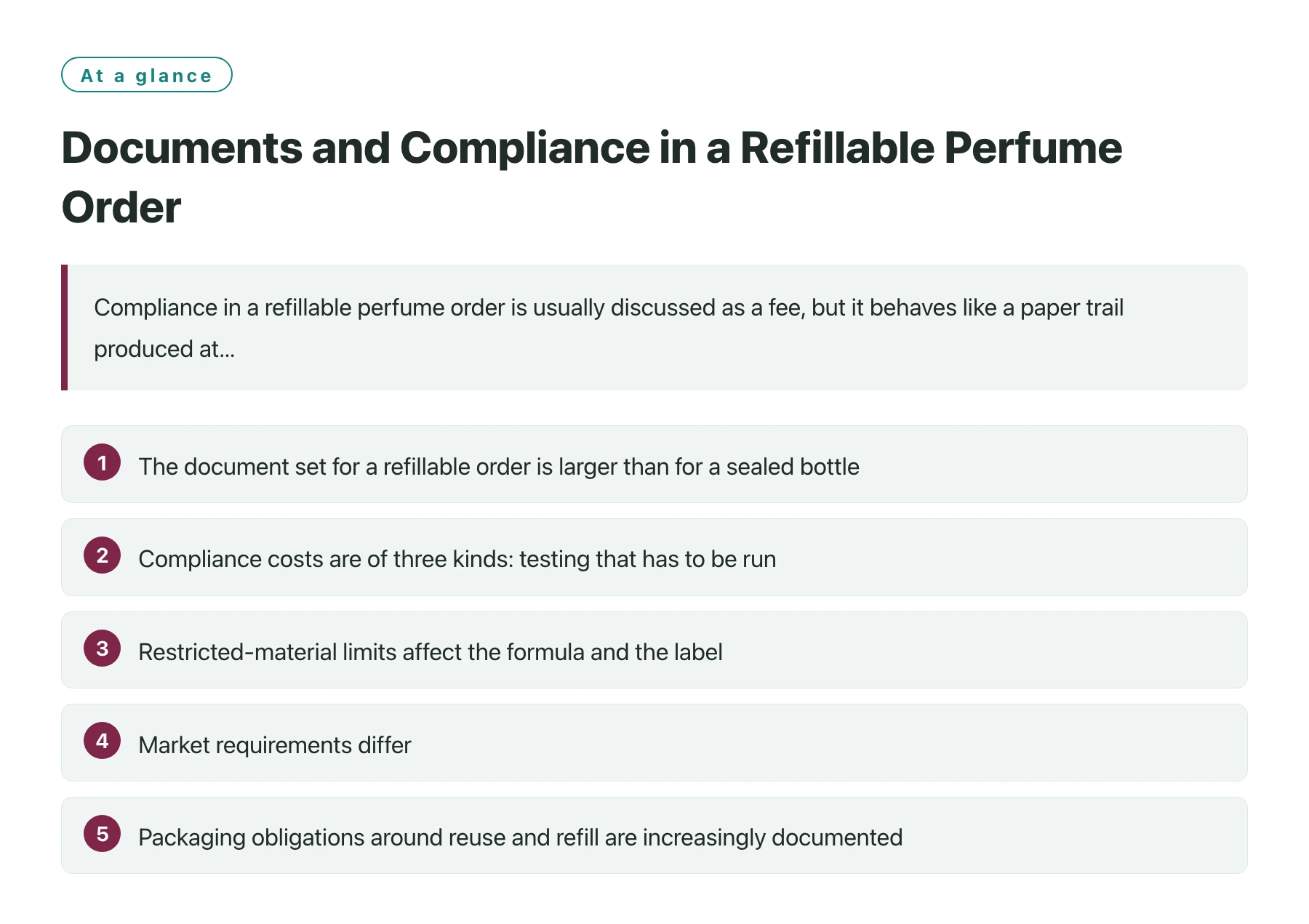
Key takeawaysThe document set for a refillable order is larger than for a sealed bottle, because the refill is a filled and labelled product in its own right. · Compliance costs are of three kinds: testing that has to be run, information that has to be submitted, and artwork that has to be changed. · Restricted-material limits affect the formula and the label, and they are cheapest to check before a direction is approved rather than after [1]. · Market requirements differ, so the destination list belongs in the brief; a product prepared for one market is not automatically ready for another [2]. · Packaging obligations around reuse and refill are increasingly documented, so the refill needs its own material and disposal information [3].
Buyers tend to treat compliance as a gate at the end of a project. In practice it is a sequence of small demands that starts with the brief and finishes with artwork, and the demands are easier to meet when they are anticipated.
A refillable format makes the sequence longer. The fragrance has its own obligations, the primary pack has its own, and the refill sits between them, being at once a cosmetic product and a package.
What follows is a map rather than a legal summary. It shows which document is produced at which point and what kind of cost it represents, so a project plan can carry the work without carrying surprises.
Why a refillable order carries more paperwork
A sealed bottle is one article. A refillable system is a primary pack, a filled refill and the interface between them, and each part generates its own evidence. The refill in particular is a small piece of retail packaging that also happens to contain a cosmetic product.
The consequence is that compliance work has to be assigned rather than assumed. In the European Union a cosmetic product requires a Responsible Person and a product information file before it is placed on the market, and that obligation is not satisfied by a supplier certificate alone [4].
A buyer's job is not to become a regulatory specialist. It is to know which document is expected at which moment, and to ask who is producing it.
Three kinds of compliance cost
Testing is the most visible: stability, compatibility between the fragrance and the refill material, microbiology where relevant, and any market-specific requirement. It is paid to a laboratory and it takes calendar time.
Information is the second kind. Formula detail, allergen declarations, safety assessment inputs and material data have to be gathered from suppliers, and gathering is labour even when no invoice is attached.
Artwork is the third. Label content, symbols, recycling information and language versions are all downstream of compliance decisions, and every late change ripples through printing.
A partner that already maintains a document set can shorten the third kind substantially. The service scope published on the Xuelei official site is a reasonable place to check which of these obligations a manufacturer is prepared to support, and which remain with the brand.
Restricted materials are a brief-time question
Materials with use restrictions can force a reformulation, and a reformulation after approval restarts sampling, validation and artwork. The Standards library maintained by the industry association is the reference most formulators work from, and it is the reason a brief should name its destination markets early [1].
Where a direction depends heavily on a restricted material, it is worth agreeing a fallback at the same time as the primary version, rather than discovering the need for one during the compliance review.
The document set, and where the cost sits
| Document | Who produces it | When it is needed | Where the cost sits |
|---|---|---|---|
| Brief and specification version | Brand, with supplier input | Before the first sample | Brand time; errors cost sample rounds |
| Safety and restriction review | Formulator or safety assessor | Before a direction is approved | Reformulation if it is late |
| Stability and compatibility report | Test laboratory | Before the pack is released | Laboratory fees and calendar time |
| Product information and safety assessment | Responsible Person | Before the product is placed on the market | Fixed setup plus updates per variant [4] |
| Allergen and ingredient declarations | Brand or supplier, from formula data | Before artwork is finalised | Artwork revisions and language versions |
| Packaging and disposal information | Brand, with supplier material data | Before printing | Material data gathering and proofing [3] |
The right-hand column is the argument for starting compliance work early: none of these costs falls, and several of them multiply, when the document is requested late.
A sequence that keeps compliance off the critical path
- State the destination markets in the brief, so restriction and labelling questions are answered while the direction is still open.
- Collect supplier material and component data at the same time as the quotation, not after the purchase order.
- Run stability and compatibility work in parallel with artwork, since they answer different questions.
- Freeze the label content only after the safety assessment inputs are confirmed, which avoids a second printing proof.
- Keep one version-controlled compliance folder per product variant, and treat the refill as its own variant.
- Confirm in writing which party holds each obligation, including the Responsible Person where the market requires one.
Buying from a partner who holds the paperwork habit
Documentation quality is easier to assess than most capability claims, because it is visible before the order. A manufacturer that can produce a blank batch record, a specification template and a material data sheet on request is not necessarily better at perfumery, but it is materially easier to audit.
That matters more in a refillable format, where the brand has to reconcile evidence from a fragrance, a component and an assembly step. It is also a fair question to put to any a contract manufacturer for perfume brands during evaluation, alongside price and lead time.
Certifications are part of the same picture. What a manufacturer holds and how recently it was audited is published by most established suppliers, and its background and certifications is a more useful first read than a brochure, because it tells you which questions the partner has already been asked by others.
Sources
- IFRA Standards Library (International Fragrance Association) —— The IFRA Standards Library lists the restrictions the fragrance industry applies to individual fragrance ingredients, based on safety assessments; it is the reference point for compliant fragrance formulation.
- Health Canada: Cosmetic Safety —— Health Canada's cosmetics pages, covering cosmetic notification, the ingredient hotlist and safety requirements for cosmetics sold in Canada.
- Sustainable Packaging Coalition —— A membership organisation working on more sustainable packaging design, publishing material and recyclability guidance.
- European Commission: Cosmetics in the EU —— The European Commission's overview of EU cosmetics rules, including the responsible person, product information file and safety report requirements.
Frequently asked questions
Is the documentation burden higher for a refillable format?
Yes, in practice. The refill is both a package and a filled cosmetic product, so it generates material data, labelling content and release records of its own. The fragrance and the primary vessel are documented as well, but those obligations exist for any format.
Who should hold the product information file?
The party acting as the Responsible Person in the market concerned. That is a commercial and legal arrangement rather than a manufacturing one, and it should be settled in writing before the first order, because the holder needs access to formula detail and safety inputs.
When should restricted materials be checked?
Before a scent direction is approved. Checking later can mean a reformulation, and a reformulation restarts sampling, validation and artwork. A brief that names its markets makes the check possible at the cheapest moment.
Can a brand reuse one compliance file across several products?
Partly. The framework and the supplier documentation can be shared, but product-specific inputs such as the formula, the safety assessment and the artwork cannot. The refill and the primary pack also need separate treatment.
How early should artwork work start relative to testing?
In parallel, with the content held open. Testing answers whether the product and pack are acceptable; artwork answers how that is communicated. Running them in sequence wastes weeks that the project will want later.